



Empathy
Understanding your world
I seek to understand your experience from your perspective, checking my understanding rather than assuming I know what it means for you.

You don’t need a clear explanation before we meet. There’s room to talk, pause, and explore what matters to you. I’ll listen with care and respect as we make sense of it together.
I’m Michael Rimmer, though most people call me Mike. I’m a person-centred counsellor and clinical supervisor.

My route into counselling has taken me through several different fields. I graduated in Chemical and Bioprocess Engineering in 1999 and completed a PGCE in 2004. Teaching was followed by caring and parent-carer roles, mentoring and advocacy. I qualified in Level 4 Therapeutic Counselling in 2017, then completed Level 5 Working with Trauma in 2024 and Level 6 Clinical Supervision in 2025.
My experiences have given me insight into carers’ lives, education and SEND, neurodiversity, and how people experience public services. They help me pay attention to the wider contexts of a person’s life and how those contexts may influence us.
I work as an inclusive and reflective practitioner. Within our therapeutic relationship, you can describe your experience in your own terms, with your differences, circumstances and priorities taken seriously. Whilst my training and experience may inform my practice, I remain open to what only you can tell me about your life and your experiences — you are the expert about yourself.
I’m a registered member of the British Association for Counselling and Psychotherapy (BACP), and my work is aligned with its Ethical Framework for the Counselling Professions.

Person-centred counselling begins with the belief that you are the expert on your own experience. I won’t tell you what you should feel or who you should become. I’ll listen carefully, seek to understand your world as you experience it, and work alongside you as you develop solutions that work for you.
As we progress, you may come to understand parts of yourself that have been difficult to hear or express. Therapeutic change can mean a movement towards who you are: finding more freedom to recognise what matters to you and live in a way that feels more authentic to you.
“The curious paradox is that when I accept myself as I am, then I change.”Carl Rogers · On Becoming a Person
Developed by Carl Rogers, person-centred theory holds that people have a capacity to develop and find their own direction when the therapeutic relationship offers the right conditions. You bring your understanding of your life; I aim to offer three central qualities:
Understanding your world
I seek to understand your experience from your perspective, checking my understanding rather than assuming I know what it means for you.
Acceptance without conditions
I value you as a person. There is space to explore difficult feelings and experiences without having to earn acceptance or present a particular version of yourself.
Realness in the relationship
I aim to be authentic and aware of my own responses, communicating openly and thoughtfully when it supports our work together.
We may learn that acceptance depends on meeting other people’s expectations. Counselling can offer room to recognise those pressures, hear your own experience more clearly and develop greater trust in your choices.
A free 30-minute online conversation to ask questions and get a sense of whether working together feels right.
Online · No commitment
You choose where we begin and what needs attention. We can talk, pause and return to things as they become clearer.
Your experience · Your pace
Meet online from anywhere in the UK, or in person in Warrington or Preston.
Warrington · Friday | Preston · Tuesday
You are welcome to email me with questions about counselling or practical access before arranging a conversation.

Bring client work, questions and the impact of the work on you. We explore together in a collaborative, person-centred relationship, with space to notice your responses, consider different possibilities and reflect on the decisions you make.
The Seven-Eyed Model helps us look at client work in context. Gibbs’ reflective cycle supports learning from experience, while Proctor’s functions bring together emotional support, development and professional accountability. We use these models flexibly, following the work you bring.
This model invites us to look at the work from seven connected perspectives: your client, what you do together, your relationship, your own responses, our supervision relationship, my responses and the wider context. A shift in focus can help us notice a pattern or an assumption that was less visible from another angle.
We can stay with one perspective or move between them as something new emerges. There is no requirement to work through all seven in every session.
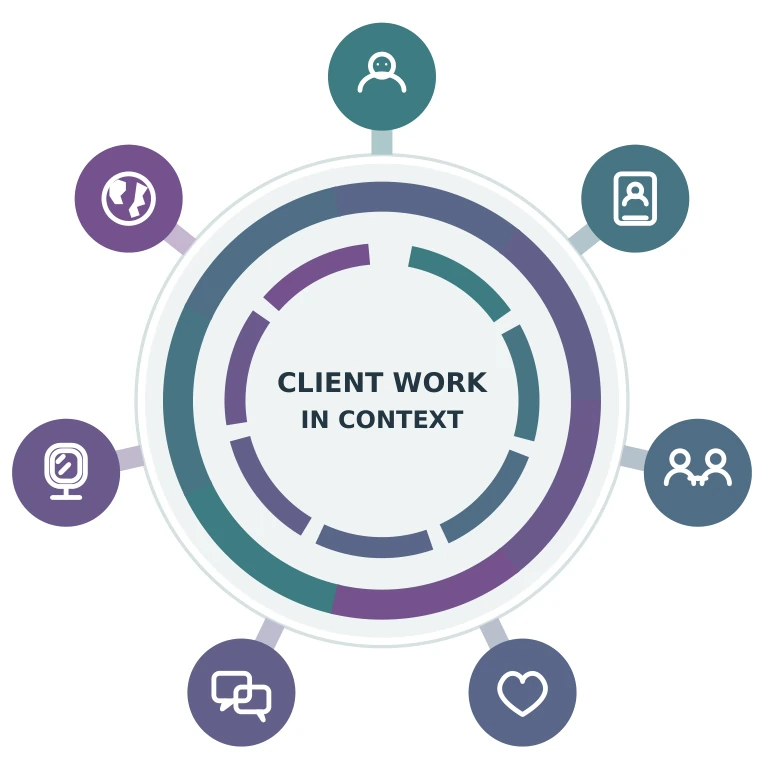
Choose a perspective to explore it.
What might the client be experiencing, and what matters to them? We can consider their account, their needs and the meanings they give to their experience, while recognising what we cannot yet know.
The reflective cycle helps us revisit an experience and turn reflection into learning. It moves from describing what happened, through thoughts and feelings, towards understanding and considering what to take forward.
We use it flexibly. Sometimes a single question is enough; sometimes it helps to explore an experience more fully. The aim is greater awareness and choice, with room for uncertainty.

What happened?
Revisit a particular moment, what you noticed and the circumstances around it.

What arose in you?
Attend to thoughts, emotions and bodily responses, then and now.

What helped or hindered?
Consider what supported the work and what felt difficult or less helpful.

What might explain it?
Explore possible meanings, relationships, assumptions and contextual influences.

What have I discovered?
Notice what you understand differently and what remains open for exploration.

How do I apply it?
Consider how this learning may inform your choices when a similar experience arises.
What you take forward becomes part of the next experience, giving you something new to reflect on.
Supervision makes room for support, learning and accountability. These functions overlap, and their balance can change according to what you bring and what your client work needs.

Space for the emotional impact of practice
A place to acknowledge the demands of the work and how they affect you. We can attend to emotional responses, capacity and support, helping you recognise what you need to sustain your practice.

Learning, insight and development
Space to deepen understanding, explore your choices and develop your practice. We can connect experience with learning, consider other possibilities and identify areas where further development would be useful.

Ethics, standards and accountability
Space to consider boundaries, competence, confidentiality and professional responsibilities. We can reflect on difficult decisions, recognise concerns and consider how to address them within the context of your work.
A discussion may offer emotional support, develop understanding and raise an ethical question at the same time. We can give each the attention it needs.
Email me to arrange an initial discussion where we can explore your needs from supervision and whether working together feels right for you.
Email me to let me know whether you’re interested in counselling or supervision. You can include anything you would like me to know at this stage.
I’ll respond by email with a short initial enquiry form. This helps us explore what you’re looking for and whether my approach may suit your needs. If we both feel it is appropriate, we can arrange an initial appointment.
Before proceeding with sessions, we’ll agree a working agreement setting out how we will work together, including fees, confidentiality and practical arrangements.
More information about how your personal data is handled can be found in my privacy notice (opens in a new tab).
Online sessions are available to people who are physically in the UK at the time of their session.